Undersized or oversized air compressors cost facilities money every day, whether through weak tool performance and lost throughput or wasted energy from a system that never stops cycling. Learning how to size an air compressor correctly starts with understanding a few core variables and applying a consistent, repeatable process. This air compressor sizing guide walks through the key numbers to track, a step-by-step method for calculating true demand, and the mistakes that trip up even experienced engineers.
Why Sizing Matters
Getting compressor sizing wrong hits a facility from two directions. An undersized system can’t keep up with peak demand. That leads to pressure drops, stalled tools, and production slowdowns exactly when output matters most. An oversized system, on the other hand, cycles more than necessary, burns extra electricity, and adds unnecessary capital and maintenance costs over the life of the equipment.
Understanding how to size an air compressor before committing to a purchase protects both uptime and the operating budget. Since compressed air often ranks among a plant’s largest energy expenses, getting the size right the first time matters for design engineers evaluating a new build and maintenance teams planning a replacement alike.
Key Variables (CFM, PSI, Duty Cycle)
Three core variables drive every compressor sizing decision. Calculating real-world demand requires evaluating how volume, pressure, and run time interact under load. These variables include:
CFM (cubic feet per minute). Measures the volume of air a compressor delivers to equipment over time.
PSI (pounds per square inch). Measures the operational pressure behind airflow, delivering the required force to end-use tools.
Duty cycle. Represents the proportion of time a compressor operates under continuous load before requiring a cooling cycle. A 50% duty cycle unit should only operate roughly half the time under full load.
A proper compressed air CFM calculation accounts for all three variables together. A compressor delivering high CFM at low pressure will fail if it cannot sustain the specific PSI required by your machinery.
Step-by-Step Method
Sizing a compressed air system correctly follows a repeatable, step-by-step engineering sequence. Plant managers and design engineers should calculate demand using actual manufacturer specs rather than rough estimates. The repeatable sequence includes the following:
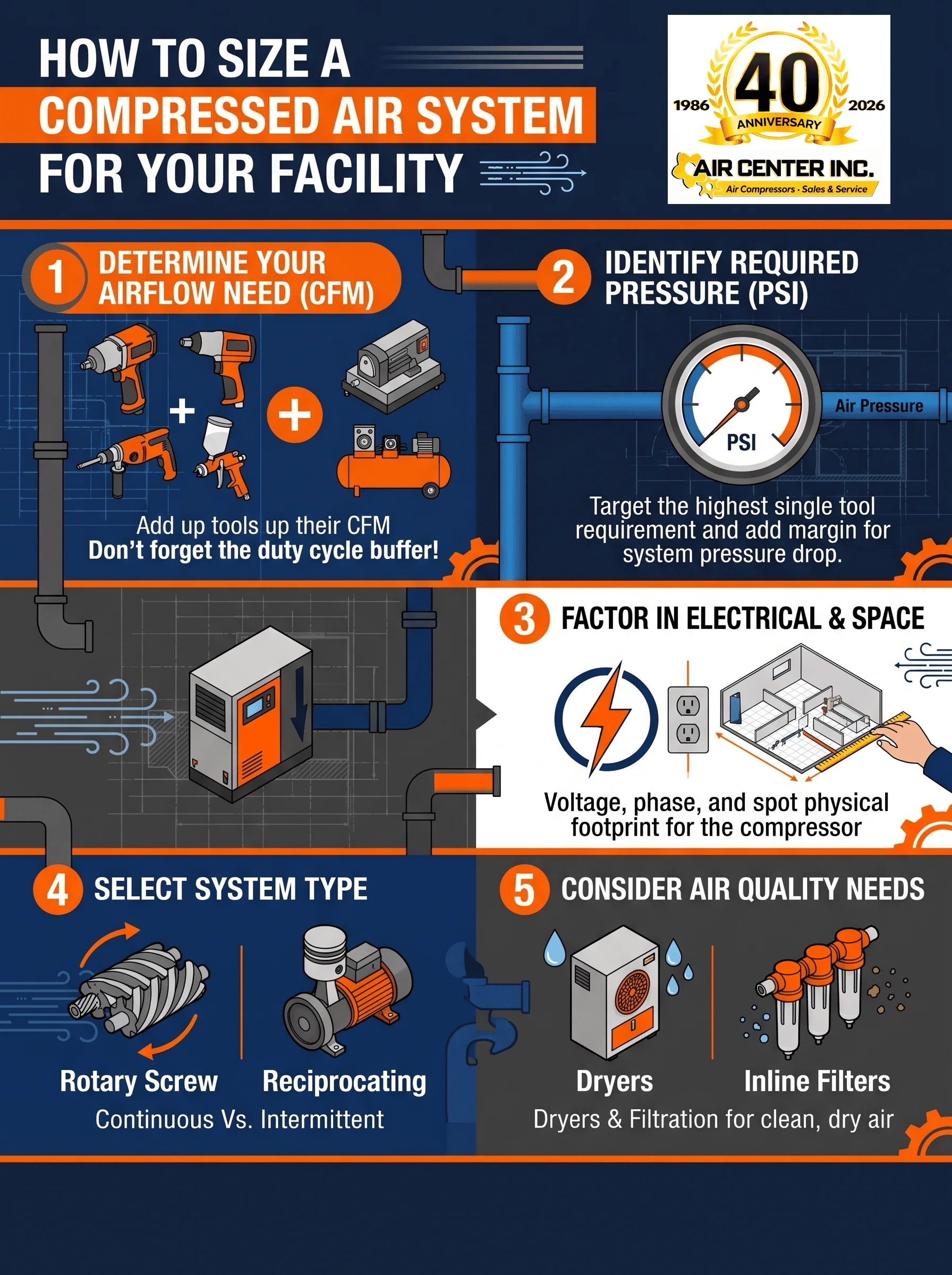
List equipment requirements. Record the manufacturer-specified CFM and PSI requirements for every tool drawing from the air system.
Apply tool duty cycles. Multiply each tool’s rated CFM by its operational duty cycle percentage to determine average real-time demand.
Calculate simultaneous peak demand. Sum the adjusted CFM of all equipment running concurrently, rather than adding total connected load at 100% usage.
Incorporate a system safety margin. Add 25% to 30% additional capacity to account for piping leaks, unexpected demand spikes, and future facility expansion.
Establish maximum system pressure. Base operating output pressure on the single tool requiring the highest PSI, adding 10 to 15 PSI to offset friction losses across dryers, filtration, and distribution piping.
Following this compressed air CFM calculation process, rather than sizing off a single tool or a rough guess, produces a far more reliable result.
Common Sizing Mistakes
Even experienced teams run into a handful of recurring errors. The most common is adding up the full nameplate CFM of every tool in the building, which almost always overstates real demand since tools rarely run simultaneously at full capacity.
Another frequent mistake is ignoring duty cycle altogether, which leads to an undersized compressor that overheats under sustained use. Some facilities focus only on PSI and assume higher pressure automatically means more power, when in reality every two psi of unnecessary pressure adds roughly 1% to energy costs without improving performance. Skipping a proper compressed air CFM calculation and relying on rough estimates is often the root cause of chronic pressure problems and premature equipment wear.
Partnering with a Compressed Air Specialist
Calculating baseline demand provides a starting point, but complex production environments require precise, real-time measurements. Facilities with variable production cycles, expanding piping headers, or overlapping equipment operation need dedicated diagnostic audits to prevent costly sizing errors.
Professional technical teams use data-logging flow meters and pressure sensors to track actual air consumption patterns over extended operational cycles. These measurements identify baseline system leaks, isolate pressure drop issues across filtration units, and verify true peak loads before capital investment.
Air Center, Inc. has engineered, installed, and serviced industrial compressed air systems across New Jersey, Eastern Pennsylvania, and New York for nearly four decades. As an authorized Kaeser distributor, Air Center combines technical diagnostic precision with field-proven rotary screw technology to optimize facility efficiency and uptime.
If your facility is experiencing pressure drops or planning a new equipment build, contact our engineering team today to request a free system sizing consultation.
